The neighborhood pharmacy has always been a place of trust, a familiar corner where you pick up your blood pressure meds or get a quick flu shot. However, the landscape is shifting in a big way. Thanks to the 2024 FDA final guidance on decentralized elements, your local independent pharmacist is no longer just a spectator in the world of high-stakes drug development. They are becoming active, essential participants. The FDA has moved away from the idea of “Decentralized Clinical Trials” as a separate, futuristic category and is instead focusing on “decentralized elements” that can be plugged into any study. This means that routine pharmacy work is now being recognized as a critical clinical research service.
So, what exactly does this look like in practice? Let’s break down the specific activities that pharmacists can now perform as part of the research enterprise.
The Power of Dispensing and Supply Chain Management
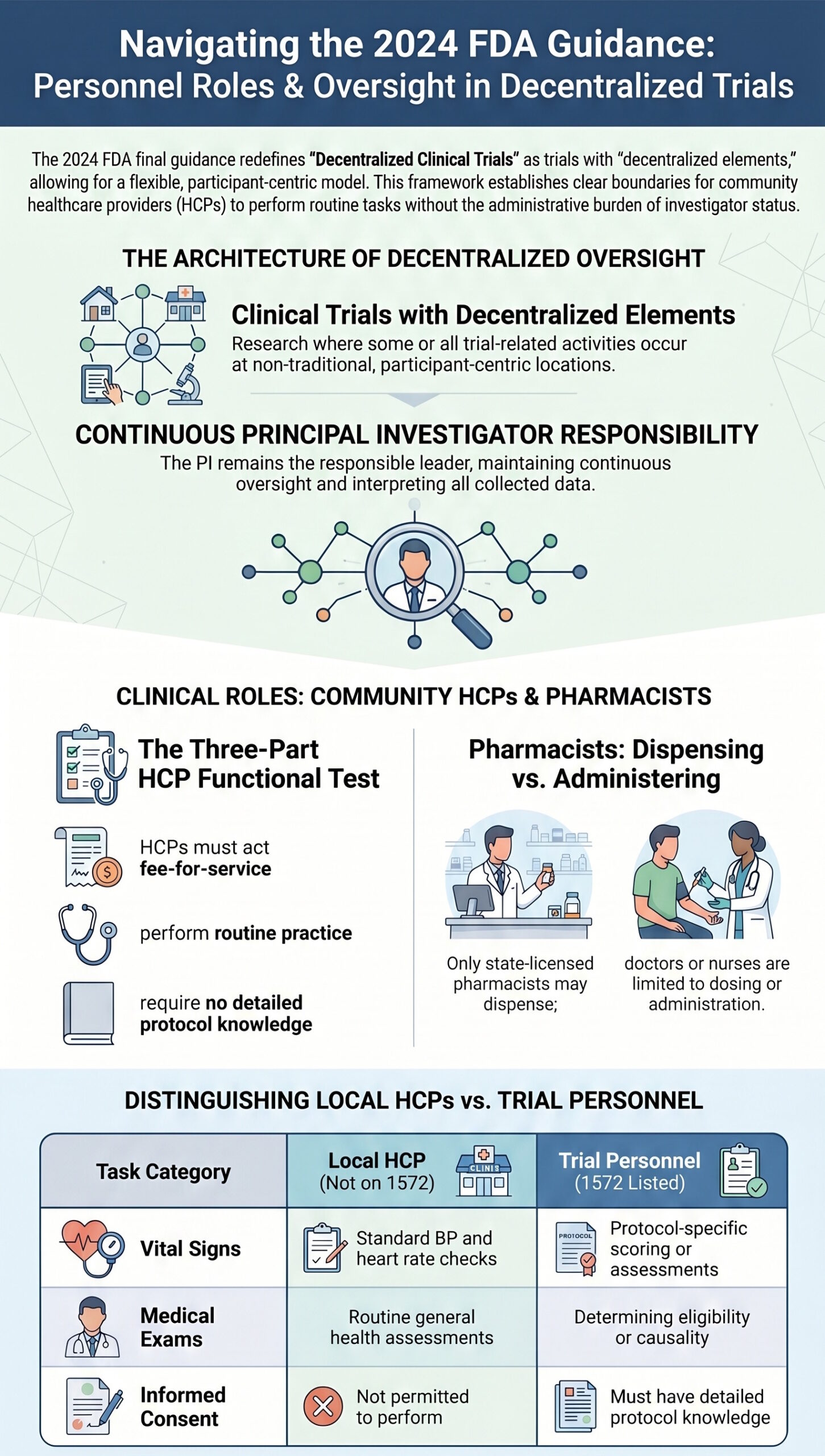
One of the most significant roles a pharmacist plays involves the actual handling of the investigational product (IP). While doctors and nurses are authorized to dose or administer medication in many settings, the act of “dispensing” is a very specific legal function. Dispensing involves preparing the drug, verifying safety parameters, and labeling it for a specific patient. This is the exclusive purview of the state-licensed pharmacist.
Under the new guidance, pharmacists can manage complex distribution models like “white bagging” and “brown bagging”. In a white bagging scenario, the investigational drug is shipped directly to the pharmacy, where the pharmacist prepares it for a provider to administer. In brown bagging, the drug is shipped to the participant, who then brings it to the pharmacist for professional oversight. This level of control ensures that experimental medications are handled with the same rigor as any other prescription, maintaining the chain of custody from the manufacturer to the patient.
Clinical Care and Medication Therapy Management (MTM)
Pharmacists are experts in how drugs interact with the human body. The FDA guidance highlights that routine services like Medication Therapy Management (MTM) and personalized patient counseling are perfect fits for clinical trials. In a research setting, this means the pharmacist can educate participants on how to properly use the study drug, what to do if they miss a dose, and how to identify potential side effects.
This isn’t just “extra” work; in many states, this level of counseling is mandated by law. By integrating these services into a trial, sponsors get a professional layer of adherence support that is often missing in traditional, site-centric models where a patient might only talk to a researcher once a month. The pharmacist becomes the day-to-day coach for the patient, ensuring the data coming back to the sponsor is clean because the patient is actually taking the medication correctly.
Objective Data Collection: Vitals and Phlebotomy
Many clinical trials require regular check-ins to monitor a patient’s health. In the past, this meant the patient had to drive hours to a major university hospital just to get their blood pressure checked. The 2024 guidance changes that by allowing local pharmacists to perform “routine clinical tests” that are well-standardized.
Specific tasks now on the table for pharmacists include:
- Vital Signs: Checking standard blood pressure, heart rate, and temperature.
- Phlebotomy: Performing routine blood draws that are then sent to a central lab for analysis.
- Physical Exams: Conducting general health assessments to ensure the patient is tolerating the study.
The key here is the “functional test” established by the FDA. As long as these activities are part of the pharmacist’s routine clinical practice and do not require detailed, specialized knowledge of the study protocol, the pharmacist can perform them as a “local HCP” rather than a formal investigator. This keeps the administrative burden low while keeping the clinical quality high.
Virtual Vigilance and Safety Monitoring
Safety is the most important part of any trial. The FDA emphasizes that participants in decentralized trials must have a clear way to report “concerning signs or symptoms”. Because pharmacists see their patients more frequently than almost any other healthcare provider, they act as an early warning system.
The guidance mandates that local providers be instructed on how to report adverse events to the Principal Investigator. If a patient walks into their local pharmacy and mentions a new rash or persistent dizziness, the pharmacist can immediately document that event and relay it to the research team. This “Virtual Vigilance” ensures that even if a trial is happening in a patient’s home, they are never truly unmonitored.
Documentation without the Red Tape
One of the biggest wins in the final 2024 guidance was the removal of the requirement for a formal “task log” for every local provider. Instead, the FDA is focusing on the “participant case history”. Pharmacists simply need to document the service they provided, their name, and the date in the patient’s record. This shift recognizes that professional documentation should follow the patient’s journey rather than an administrative checklist, making it much easier for independent pharmacies to say “yes” to participating in research.
Bibliography
- Comprehensive regulatory analysis of decentralized clinical trials under the 2024 FDA final guidance.
- DIA Global Forum. (2025). Navigating US Regulations for Dispensing Investigational Drugs in Decentralized Clinical Trials.
- Faget, K. (2025). What The FDA Says About Investigator Responsibilities In DCTs. Clinical Leader.
- Medidata. (2025). Decentralized Clinical Trials: FDA Guidance Analyzed.