The Pharmacy as a Clinical Research Hub: Navigating Investigative Roles under the 2024 FDA Guidance
The landscape of clinical research is currently undergoing its most significant structural transformation since the formalization of Good Clinical Practice (GCP) standards. On September 17, 2024, the U.S. Food and Drug Administration (FDA) released its final guidance, “Conducting Clinical Trials With Decentralized Elements,” which serves as the definitive regulatory blueprint for integrating remote trial activities into the drug development lifecycle. This modernization effort represents a decisive move away from rigid, site-centric models of the past toward a fluid, participant-centric architecture. Central to this evolution is the explicit authorization for utilizing local healthcare providers (HCPs), specifically including community-based pharmacists, to perform trial tasks.
The Core Question: Can Pharmacists Perform Investigative Roles?
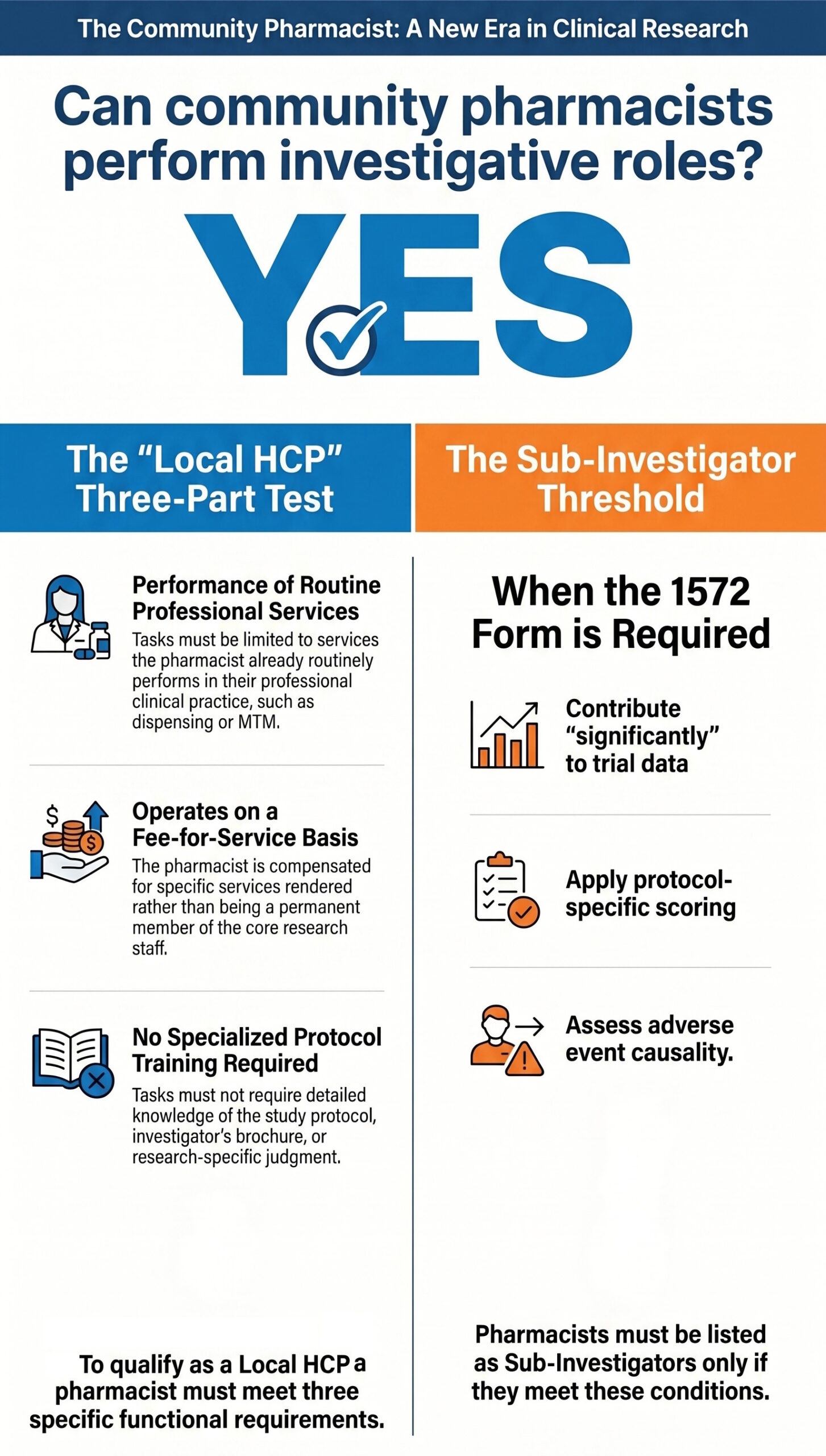
The answer, underpinned by the 2024 guidance, is a definitive YES. However, the nature of that role depends on a nuanced “functional test” established by the FDA. For independent community pharmacists, the opportunity to participate in clinical research has never been more accessible, provided they understand the regulatory distinction between acting as a “local HCP” and a formally designated “sub-investigator”.
The FDA now views decentralization as a “menu of tools” that can be implemented á la carte to enhance trial efficiency and participant diversity. In this framework, the local pharmacy is recognized as a key decentralized element where trial-related activities can occur.
Defining the Regulatory Threshold: Local HCP vs. Sub-Investigator
The 2024 guidance facilitates the performance of “simple trial tasks” by community clinicians who do not necessarily possess detailed knowledge of the study protocol. To operate as a “local HCP” without being listed on the formal Form FDA 1572, a pharmacist must meet three specific criteria:
- Fee-for-Service Basis: The trial-related activities must be performed on a fee-for-service basis rather than through a formal research contract with the sponsor.
- Routine Practice: The services provided must be those the pharmacist routinely performs in their professional clinical practice.
- Limited Protocol Knowledge: The tasks must not require specialized training or “detailed knowledge” of the study protocol, the investigator’s brochure, or the unique properties of the investigational product (IP).
If a pharmacist’s involvement exceeds these boundaries, for instance, if they “directly and significantly” contribute to the trial data by performing subjective research assessments or applying protocol-defined scoring systems, they should be formally designated as sub-investigators and listed on the Form FDA 1572.
The Unique Pharmacy Advantage: Dispensing vs. Administering
Community pharmacists occupy a unique and central role in the FDA’s vision for decentralized research. Unlike other local HCPs, such as nurses or physicians, pharmacists are already legally authorized and physically equipped to handle the storage, labeling, and dispensing of regulated substances. This is a critical distinction in the regulatory landscape; while many HCPs can dose or administer medication, the act of dispensing, which involves preparing the drug and verifying its legal and safety parameters, is the exclusive purview of state-licensed pharmacists.
The 2024 guidance acknowledges that pharmacists can facilitate the “white bagging” of IPs (shipping directly to the pharmacy for provider administration) or “brown bagging” (shipping to the participant to bring to the pharmacy). By serving as these authorized practitioners, pharmacists provide a layer of safety and professional oversight that is vital for decentralized models.
Routine Tasks and Clinical Integration
Under the new framework, pharmacists can integrate several trial-related tasks into their routine workflow. These include:
- Medication Therapy Management (MTM): Providing counseling and education on drug use and adherence, which is often already mandated by state laws.
- Vital Signs and Routine Assessments: Performing standard blood pressure, heart rate, and temperature checks as part of a general health status assessment.
- Phlebotomy: Conducting routine blood draws to be sent to central laboratory facilities for processing.
- Safety Monitoring: Acting as a “vital link” in the safety chain by reporting “concerning signs, symptoms, or clinical events” to the Principal Investigator (PI).
Oversight and the Hierarchy of Remote Leadership
While pharmacists may perform the tasks, the FDA is clear that the Principal Investigator (PI) remains the “responsible leader” of the research team. The PI must maintain continuous, rather than episodic, oversight of the trial, even when activities are decentralized across a network of pharmacies. This “hierarchy of remote leadership” requires the PI to review all incoming data from local pharmacists to detect errors or missing information.
To maintain this oversight, the guidance recommends that investigators only enroll as many participants as they can “appropriately manage”. Furthermore, pharmacists participating in the clinical trial team will generally require basic Good Clinical Practice (GCP) training to ensure they understand the ethical standards and accountability requirements for unapproved products.
The Future of Community-based clinical trials
The release of the 2024 guidance is a formal endorsement of the clinical capacity of community pharmacists. It acknowledges that the pharmacy is often a more accessible and trusted healthcare environment than a distant academic research center. For thought leaders like RxE2, this regulatory shift provides the evidence needed to advocate for the pharmacy as a primary site of research innovation.
By removing burdensome requirements like the mandatory “task log” and focusing instead on individual participant case histories, the FDA has cleared the administrative path for pharmacies to become permanent fixtures in the clinical trial ecosystem. As the boundary between clinical practice and clinical research continues to blur, the community pharmacist stands at the forefront of a more inclusive, efficient, and patient-centric era of medicine.
Bibliography
- U.S. Food and Drug Administration. (2024). Conducting Clinical Trials With Decentralized Elements: Guidance for Industry, Investigators, and Other Interested Parties.
- Comprehensive regulatory analysis of decentralized clinical trials under the 2024 FDA final guidance.
- Federal Register. (2024). Conducting Clinical Trials With Decentralized Elements; Guidance for Industry, Investigators, and Other Interested Parties Availability. (89 FR 76481).
- ACRP. (2024). The FDA’s Final DCT Guidance—Agency Now Serving Up Decentralized Elements À La Carte for Fit-for-Purpose Trials.
- Medidata. (2025). Decentralized Clinical Trials: FDA Guidance Analyzed.
- Faget, K. (2025). What The FDA Says About Investigator Responsibilities In DCTs. Clinical Leader.