Written by: Andy Russell, Vice President, Growth & Product Strategy at RxE2
The San Diego Signal: An Industry Carrying a Heavy Load
There was a moment coming out of GCSG this year where something started to feel different. Not because we suddenly discovered new problems. We didn’t. If anything, the industry showed just how well it understands its own challenges.
What stood out to me was the weight of it all. The supply chain leads, ops teams, pharmacists, and partners in those rooms, they weren’t talking in hypotheticals. They were talking about the day-to-day reality of trying to keep incredibly complex clinical trials moving forward under real pressure and global uncertainty.
Forecasting fatigue. Labeling delays. Accountability burdens. Enrollment that refuses to behave the way we want it to. Even geopolitical activities stalling trade routes and energy production. None of this is new. But the consistency of it is hard to ignore. And it raises a tougher question:
Are we solving these problems… or just managing around them?
The “Better Forecasting” Illusion
If you sat through enough sessions, a clear pattern emerged. We are putting a lot of energy into trying to predict the future better. Better models. Better simulations. More advanced analytics. Smarter ways to anticipate enrollment behavior, site performance, patient demand. There’s real brilliance behind that work. It deserves respect.
But there’s a tension underneath it. Because even as the models improve, the core dependency doesn’t change:
We are still making decisions about manufacturing, packaging, and labeling before a patient exists to receive the medication.
No matter how good our math is or how comprehensive our data and analytics are, that’s a hard constraint to work against. At some point, I wonder when it makes sense to ask, “Are we optimizing the right variable?”
The Root Cause We Don’t Talk About Enough
If we step back and zoom out, most of the challenges we discussed in San Diego start to connect. Waste. Delays. Rework. Operational drag. Governance complexity. They all trace back to one idea:
We put too much value at risk before we actually know when and where it’s needed.
Medication is manufactured, packaged, labeled, and positioned months before a patient is confirmed. It’s a natural response to uncertainty. We’re trying to stay ahead of demand. The strategy perfectly matches the era it was born out of. But that same approach creates fragility.
Clinical trials don’t behave in straight lines. Protocols change. Enrollment shifts. Regions scale up and down, or fail to start altogether. And when they do, the supply chain struggles to adapt because the product is already fixed in a version of the future that didn’t happen. That’s not a forecasting issue. That’s structural.
The 40% Overage Reality
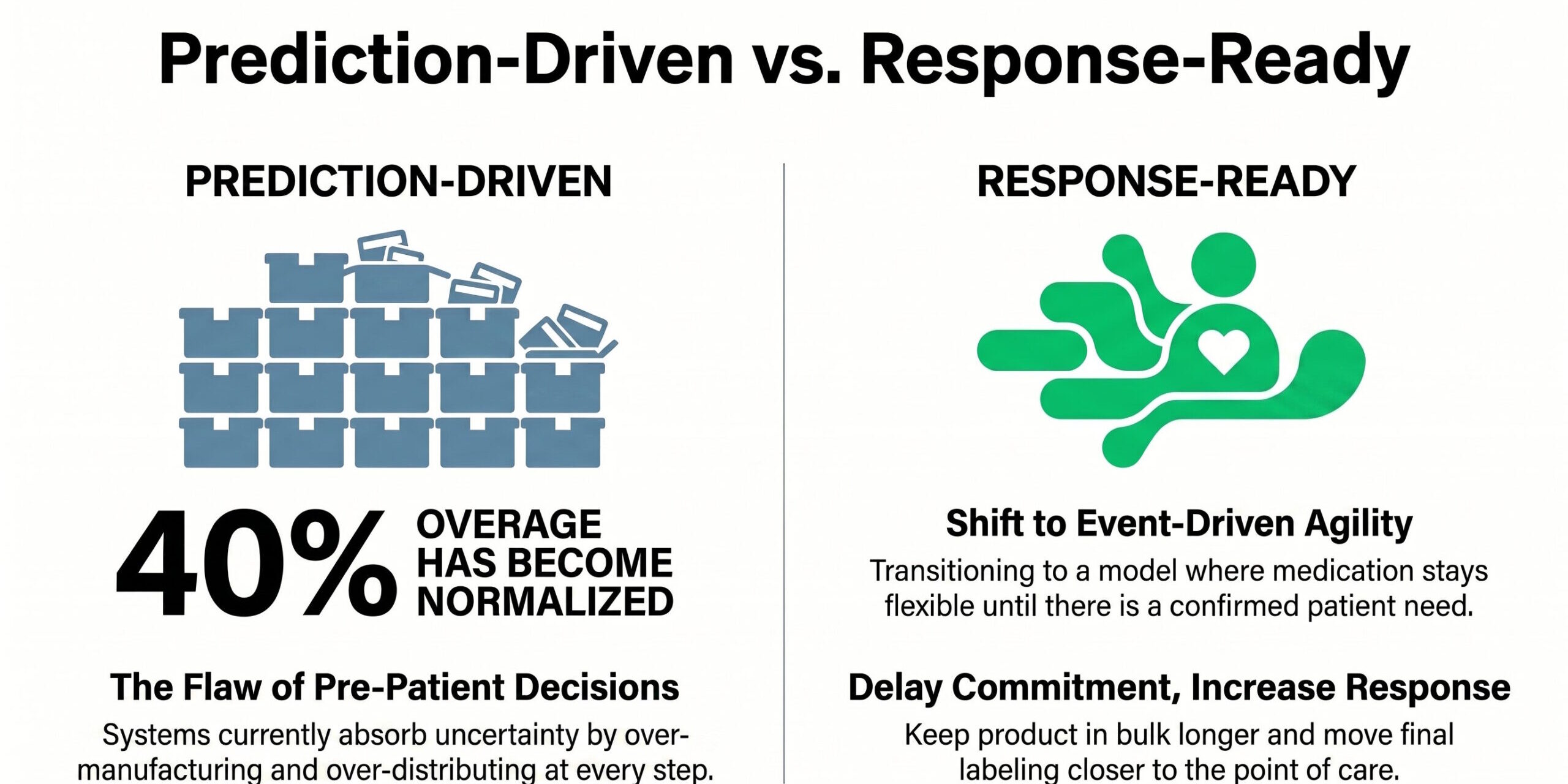
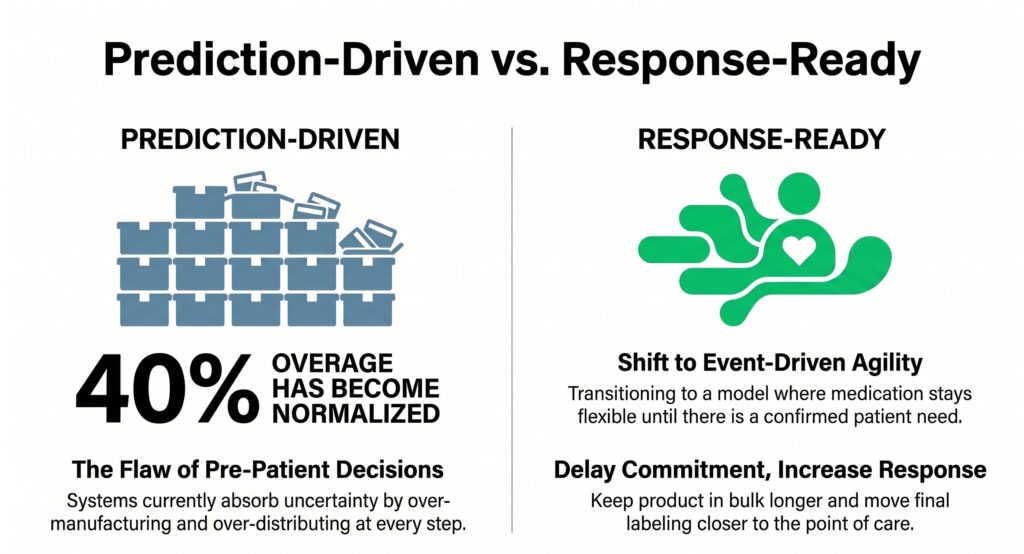
One of the more sobering realities coming out of GCSG is how normalized certain numbers have become. 20%. 30%. 40%. 100%!!!
Overage at these levels is often treated as just part of the model because it’s how we’ve always needed to do it. If you zoom out, what is this telling us?
You might see we are designing systems that assume uncertainty and then absorb the cost of that uncertainty upfront. We manufacture extra. We label extra. We distribute extra. It’s not because teams are inefficient or careless. If you know clinical supply professionals, you know they are hyper-efficient and supremely dedicated. But the system we’ve created requires things to function this way. And over time, those decisions stack up into a structural waste waterfall. We’re sinking value at every step before product ever reaches a patient.
A Different Way to Think About the Problem
Instead of asking:
How do we get better at predicting demand?
What if we asked:
How do we reduce our dependence on prediction altogether?
How might that shift change the conversation?
Because now we’re not trying to improve the same model. We’re questioning whether the model itself still makes sense for the level of complexity we’re dealing with today. One idea gaining traction is moving toward a more event-driven approach. In an event-driven approach, medication stays in a flexible state until there’s a confirmed need tied to an actual patient.
In practical terms, that can mean:
- Keeping product in bulk longer
- Moving final labeling closer to dispensing to a patient
- Leveraging licensed pharmacists—the medication experts—at the point of care
The goal isn’t perfection. And it’s not a silver bullet. But it does move the moment of commitment closer to the moment of need. That could change the risk profile of the entire system.
The Agility Question
Once you start thinking this way, the conversation expands beyond just waste. It becomes a question of agility. How quickly can we respond to what is actually happening in a trial, not what we thought would happen when we planned it out months ago?
Why This Matters
Don’t let busyness distract you from why we do this. There are patients waiting on these therapies. Some are part of large, well-understood disease areas. Others are participating in trials for conditions that may only affect a handful of people globally. Across both ends of that spectrum, the expectation is the same:
That the system works.
Shifting From Prediction to Response
If there’s one takeaway from GCSG 2026, it’s not that we need to get better at forecasting. It’s that we may need to rebalance what forecasting is expected to solve. Prediction will always be part of clinical supply. But maybe it shouldn’t carry the weight of the whole system. Maybe the goal isn’t to eliminate uncertainty. Maybe it’s to build systems that can respond to it better. That’s where the idea of moving from prediction-driven supply to response-ready supply becomes interesting.
Not as a finished answer. But as a direction worth exploring… together.